
The search for fresh, smooth and radiant skin often leads to questions about how to choose the right product among the many cosmetic solutions. For many women between 25 and 40, hydration and natural beauty are not a fashion, but a daily care. That is why hyaluronic acid, with its ability to retain water up to 1000 times its own weight, becomes a key factor in maintaining a youthful and elastic appearance. In this guide, you will find practical information about the real effects of hyaluronic acid, as well as which myths to ignore when choosing.
Contents
- What is hyaluron and basic myths?
- Types of hyaluronic acid and distinctive properties
- How does hyaluronan work on the skin?
- Key benefits for youthful and hydrated skin
- Risks, contraindications and what to avoid
Basic extracts
| Point | Details |
|---|---|
| Hyaluronic acid is a natural molecule. | It is found in the body and plays a key role in skin hydration and elasticity. |
| Different types of hyaluronic acid | High, medium and low molecular weight offer different benefits and depths of action. |
| Regularity of application is important | For visible results, regular use of hyaluronic acid is necessary, as the body breaks it down quickly. |
| Safety and risks | Hyaluronic acid is safe for cosmetic use, but injections require professional intervention due to the risks of complications. |
What is hyaluron and basic myths?
Hyaluronic acid is a natural molecule that is already present in your body. It is a polysaccharide found in synovial fluid and other tissues, responsible for maintaining moisture and elasticity. It is not a synthetic chemical, nor is it something exotic. The molecule functions like a sponge, capable of absorbing up to a thousand times its own weight in water. To put that into perspective: a single micromolecular particle of hyaluron can hold huge amounts of water around itself, creating a protective coil of moisture.
Your skin produces hyaluronic acid naturally in your younger years. In your 20s, you have optimal levels. In your 30s, levels start to decline by about 5 percent each year. By your 40s, the difference is visible in the mirror as fine lines, less toned skin, and overall drier skin. This is pure biology of the process, not some cosmetic marketing hype.
Main myths that exist:
The first myth is that hyaluronic acid goes directly into the deeper layers of the skin and fills wrinkles from within. This simply doesn’t happen. Hyaluronic acid molecules are too large to pass through the epidermal barrier when applied topically. Instead, they work on the surface layer, trapping water in the stratum corneum and leaving the skin with a smoother, more hydrated appearance. The smoother appearance makes fine lines look less visible, but this is a superficial effect, not a transformation.
The second myth is that hyaluronic injections are permanent or that a synthetic should solve all your hydration problems. Hyaluronic acid is naturally broken down by your body over time. In cosmetic use, the duration of visible results usually ranges from 3 to 6 months. You need to maintain regular application if you want permanent results. This is an informed practice, not a miracle solution.
The third myth is that all hyaluronic products work the same. Molecular weight varies greatly. High molecular weight stays on the surface more and is excellent for hydration. Low molecular weight has the ability to penetrate deeper into the skin, although not deep enough to fill skin imperfections. Formulations with different molecular sizes have different effects and different use cases.
Expert Tip When choosing a product with hyaluronic acid, check the ingredient list for molecular weight or look for combination formulas with different molecular sizes for maximum hydration benefits on all levels.
Types of hyaluronic acid and distinctive properties
Hyaluronic acid is not a single product. There are different types that vary greatly in their structure and the way they act on the skin. The key difference lies in the molecular weight, which determines everything: how long it stays in the skin, how evenly water molecules can bind to it, and what level of depth they can reach. Hyaluronic acid of different molecular sizes exists in a wide range, from small molecules to huge structures, each with its own role in cosmetic and medical use.
High molecular weight hyaluronic acid, with a molecular weight of over one million Daltons, sits on the skin's surface and acts as an invisible film. It's a go-to choice for daily hydration because it won't push anything deep down. Instead, it forms a protective film that locks in moisture where it already exists. The result is smooth, radiant, and visibly plumper skin. It's perfect for your morning skincare routine when you want to boost existing moisture.
Low molecular weight hyaluronic acid, on the other hand, has a molecular weight of less than one million Daltons and penetrates deeper into the skin. This type has the ability to stimulate the biological activity of cells, inciting natural processes of repair and collagen production. It is more active in the sense of promoting cellular functions, rather than simply retaining water. For women in their 30s and 40s who are concerned with prevention and improvement of skin texture, the low molecular weight form is a practical tool.
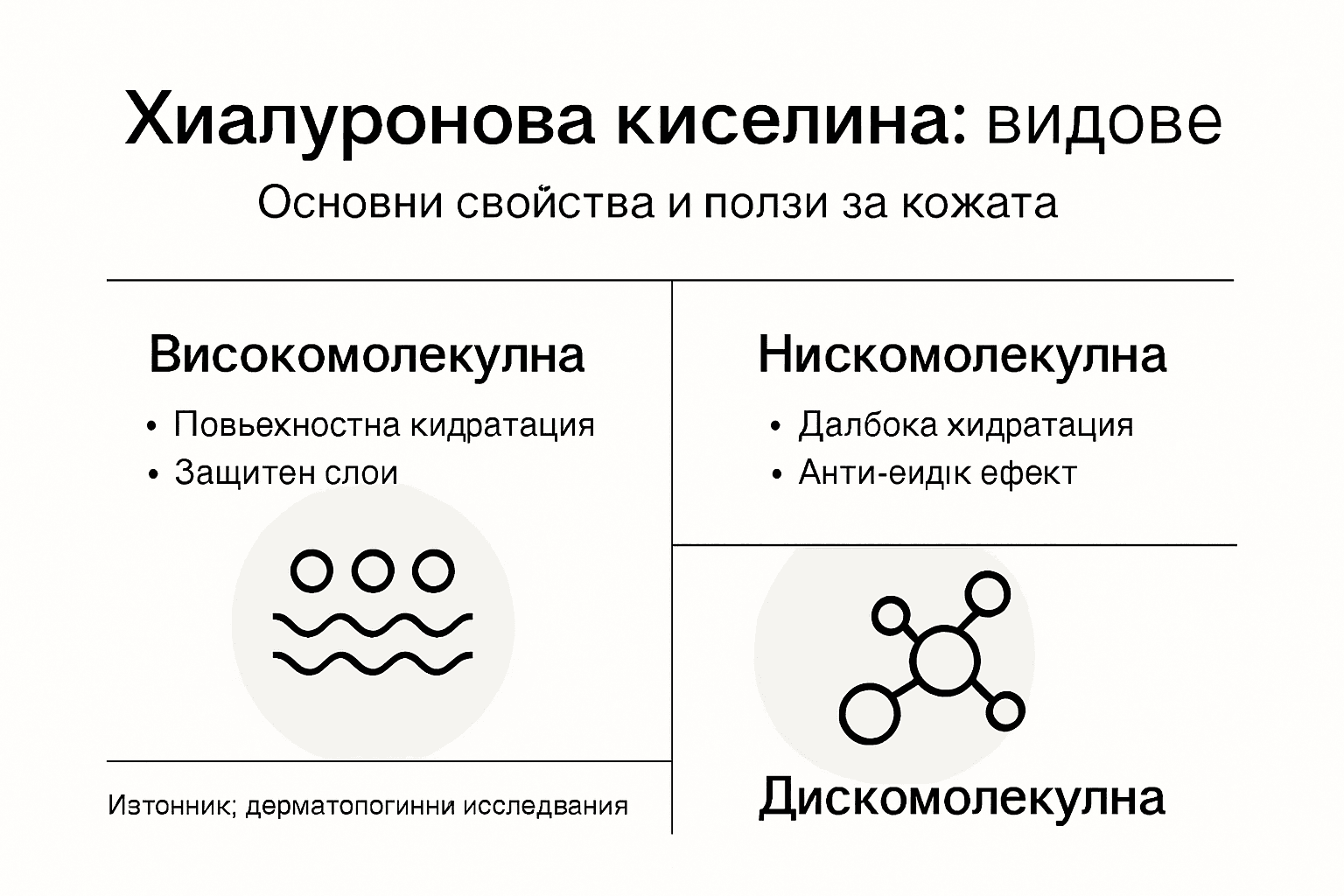
The medium molecular version, which varies between these two extremes, offers a balance of both. It penetrates moderately, retains moisture significantly, and has some biostimulating activity. Many modern cosmetic formulas combine all three sizes to achieve a complex effect. The idea is that different molecular sizes work synergistically: the largest ones stay on the surface, the medium ones penetrate partially, and the smallest ones reach deeper.
Properties of hyaluronic acid according to molecular weight:
- High molecular weight (over 1 million Daltons): Surface hydration, dense film, visible radiance results
- Medium molecular weight (500,000 to 1 million Daltons): Balanced penetration and hydration, moderate biostimulation
- Low molecular weight (under 500,000 Daltons): Deep penetration, cellular activation, support for collagen synthesis
One important note: biocompatibility and biodegradability are inherent properties of hyaluronic acid, meaning that the body tolerates it perfectly and breaks it down naturally without accumulation. There is no risk of allergic reactions or side effects with normal use. This safety is one of the reasons why hyaluronic acid is so popular in cosmetics. Your body simply uses it and then eliminates it, similar to its natural cycle.
Here is a brief comparison between the different types of hyaluronic acid and their effect on the skin:
| Type of hyaluronic acid | Depth of action | Main advantages | Suitable for |
|---|---|---|---|
| High molecular weight | Only the surface | Protects moisture, smoothes | Dry, sensitive skin |
| Medium molecular weight | Moderate penetration | Improves texture, stimulates partial | Combination skin |
| Low molecular weight | Deeper layers | Stimulates repair and collagen | Aging prevention |
Expert tip: If you have combination skin with a dry area around the eyes and nose, choose a product that combines high and low molecular weight hyaluronan to get surface hydration where it's needed and deep activation in areas with more signs of aging.
How does hyaluronan work on the skin?
Hyaluronic acid works in the skin as a biological humectant, which means it actively attracts and retains water. But this is not a passive process. Hyaluronic acid molecules bind to water molecules in the extracellular matrix and hold them there, keeping the eye hydrated deep in the epidermis. Water retention in the extracellular matrix is the key action that transforms dry, responsive skin into a smooth and supple surface. This does not happen by chance or quickly. Within the first two to three days of regular application, you will begin to notice a change in skin density and smoothness.
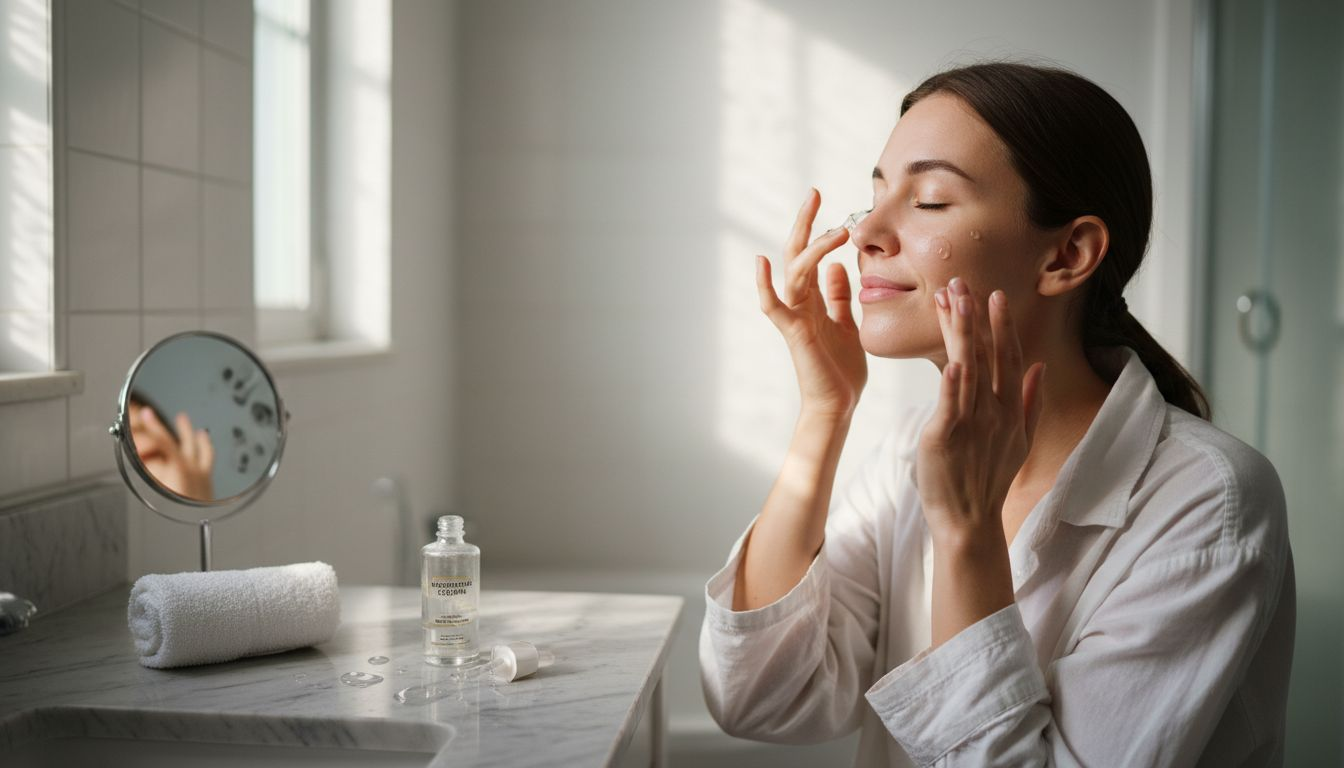
The cells in your skin respond to the presence of hyaluronic acid by activating their repair processes. It stimulates cell proliferation, which means that cells multiply and renew themselves more quickly. This is especially important because aging is characterized by a decrease in cellular metabolism. When you introduce hyaluronic acid, you are essentially signaling the cells to work more actively, to repair themselves and to produce more collagen. The visible result is fewer visible wrinkles because the spaces between the cells are filled with water and hyaluronic acid. The lines do not disappear, but they lose their depth.
One of the most interesting findings is that hyaluronic acid supports skin healing by managing moisture and local immune response. In case of injuries or irritated skin, hyaluronic acid does not just hydrate, but actively participates in the repair process. It binds to specific receptors on cells, which activate healing pathways and reduce inflammation. That is why dermatologists recommend hyaluronic acid products not only for anti-aging, but also for irritated or sensitive skin. It works as a moisturizing shield and an inflammation regulator at the same time.
It is important to understand that results depend on regularity. Hyaluronic acid does not accumulate in the body. Your body uses it, breaks it down and eliminates it. This means that if you stop using it, the levels inside the skin will decrease again. Regular use, every day in the morning and evening, is what maintains visible changes. For women in their 30s and 40s who are concerned with prevention and long-term skin care, this is an investment in ongoing maintenance, not a one-time treatment.
The process of action:
- Attraction of water molecules into the extracellular matrix
- Filling the spaces between cells with hydrated hyaluronan
- Stimulation of cell proliferation and collagen synthesis
- Reducing the visibility of wrinkles and lines
- Activation of regenerative processes in irritated skin
Expert Tip: Apply hyaluronic serum to damp skin immediately after cleansing to maximize its ability to attract and retain water, then follow with a light moisturizer.
Key benefits for youthful and hydrated skin
Hyaluronic acid offers a whole range of benefits that speak directly to the concerns of women your age. The first and most visible benefit is deep hydration . The ability to hold up to 1,000 times its weight in water makes hyaluronic acid almost magical for dry skin. When skin is properly hydrated, everything looks different. The texture is smooth, the color is more even, and even pores look smaller. This is not just a cosmetic effect. Well-hydrated skin is healthy skin that resists external pollutants and stress better.
The second benefit is a visible reduction in wrinkles and fine lines . Clinical studies have shown that treatment with products containing hyaluronic acid leads to a visible reduction in wrinkles and improved skin texture. But it is important to understand how it happens. Hyaluronic acid fills the microscopic gaps between cells, making the skin look firmer and more youthful. Expression lines gradually decrease over the weeks. After a month of regular use, the difference is obvious. After two to three months, the results are sustainable. This is a progression that you can see in the mirror.
Improved elasticity and turgor is a third significant benefit. Young skin has a natural elasticity that is gradually lost. Hyaluron restores this quality by retaining moisture in the dermal layer. The skin becomes firmer, more lifted, and the facial figure remains more defined. This is especially important for women who notice the first signs of sagging around the jaw or cheekbones. Regular use of hyaluron helps to maintain youthful facial contouring.
Antioxidant protection is another critical benefit that is often overlooked. Hyaluronic acid has the ability to neutralize free radicals that cause oxidative stress and premature aging. During the day, when you are exposed to the sun, pollutants, and stress, free radicals attack the skin. Hyaluronic acid works as a protective layer, reducing this pressure. This is a prevention of aging, not a treatment for problems that have already occurred.
Main benefits in brief:
- Deep hydration that lasts all day
- Reduce the appearance of fine lines within weeks
- Improved elasticity and younger-looking skin
- Protection against oxidative stress and free radicals
- More even skin tone and brightness
- Under-supporting natural collagen production
Expert Tip Combine hyaluronic serum with vitamins and collagen, as in Fish Collagen with Hyaluronic for Youthful Skin , for a synergistic effect that works from the inside and outside of the skin.
Risks, contraindications and what to avoid
Hyaluronic acid is safe for topical application to the skin in cosmetic forms such as serums and creams. When used topically, the risks are minimal. However, you should be aware that not all forms of hyaluron are equally safe . Contraindications and potential problems vary greatly depending on the method of application.
When it comes to injection procedures, the situation is completely different. The use of hyaluronic fillers can lead to various complications , including hematomas, inflammation, infections, allergic reactions and, in rare cases, serious problems such as skin necrosis. When a needle pierces the skin, the risk of bacterial contamination increases exponentially. If the procedure is performed by a non-professional, the injectable can reach a blood vessel, causing swelling, pain and even irreversible tissue damage. Reduced vision is a rare but documented adverse event with injections in the periorbital area. For this reason, injections should be performed by licensed dermatologists or plastic surgeons, not in spa centers or by unqualified operators.
When applied topically, the risks are incomparably lower. The overall safety of hyaluronate in cosmetic products has been confirmed by independent expert panels . You can apply hyaluronate to your skin every day without the risk of accumulation or long-term damage. Local irritation is a rare occurrence, usually when using very low molecular weight products on sensitive skin. If you notice redness or peeling, simply stop using it and switch to a milder formulation.
Specific contraindications and scenarios you should avoid:
- Active skin infection or herpes in the area where you want to apply the product
- Open sores or serious skin wounds
- Known allergy to any of the ingredients of the specific product
- Systemic treatment with blood-thinning medications before injection procedures
- Autoimmune diseases in which consultation with a doctor is mandatory before use
- Pregnancy in which some experts recommend a conservative approach
You should also understand that product quality is critical . Cheap hyaluronic serums from unknown brands may contain contamination or incorrect concentrations of the active ingredient. Invest in brands that have scientific research, transparent ingredient lists, and an established reputation. Applying hyaluronic in combination with other active ingredients like vitamin C or powerful peels can cause irritation. If you use retinol or acids, stick with a gentler hyaluronic formula and apply it as a protective layer after your active products.
The following table summarizes the main risks and appropriate measures regarding the method of administration of hyaluronan:
| Method of use | Main risks | Recommended measures | Who is it suitable for? |
|---|---|---|---|
| Cosmetic serum | Mild irritation on sensitive skin | Avoid aggressive formulas, choose proven brands | Daily care, all skin types |
| Injectable fillers | Inflammation, infection, hematomas, very rarely necrosis | Only at a dermatologist, sterile environment, medical supervision | Those who want a more visible, faster effect |
Another important point: when getting injections, make sure the artist uses sterile needles, works in a sanitary environment, and is willing to discuss possible complications. Keep in mind that the results of injections are temporary. Regular maintenance every three to six months is necessary, which means recurring costs and recurring risks. For prevention and long-lasting results without medical risks, cosmetic products with hyaluronic acid are the safest choice.
Expert Tip: If you are taking Omega 3 or fish oil, be aware that they have mild anticoagulant properties, which means that bruising may be more visible after hyaluronic acid injections; consult your doctor before combining Omega 3 and fish oil with invasive procedures.
Discover the power of hyaluronic acid for your skin with FeelYou
Hyaluronic acid is the key to deep hydration and youthful-looking skin. If you’re noticing the first signs of dryness, fine lines, or loss of elasticity, this article explains important truths about molecular weight and how it affects the action of hyaluronic acid. Choosing the right product with a combination of high-molecular and low-molecular acid will help you retain moisture and activate your skin’s natural repair process.
Don't wait for your skin to tell you it needs care, visit FeelYou and choose from over 30,000 products with hyaluronic acid tailored to your needs. Take advantage of expert advice and formulas that combine hyaluronic acid with beneficial vitamins and collagen for complete support. Explore all the solutions for youthful and hydrated skin in our online store and take the first step towards visibly healthier skin today.
Frequently Asked Questions
Why is hyaluronan important for the skin?
Hyaluronic acid is important for the skin because it retains moisture, which helps maintain hydration and elasticity. This molecule helps fill the spaces between cells, which reduces the appearance of wrinkles and fine lines.
What is hyaluronic acid?
Hyaluronic acid is a natural polysaccharide produced by the body and found in synovial fluid and other tissues. It can absorb up to a thousand times its own weight in water, making it an exceptional hydrator.
How do I choose the right product with hyaluronic acid?
When choosing a hyaluronic acid product, pay attention to the molecular weight. High molecular weight hyaluronic acid stays on the surface of the skin, while low molecular weight penetrates deeper and stimulates cellular activity. Combining different molecular sizes provides maximum benefits.
How long do the effects of hyaluronic injections last?
The effects of hyaluronic injections usually last from 3 to 6 months, after which repeated applications are necessary to maintain the results.
Recommended
- The 7 best vitamins for skin and how to use them effectively
- Collagen Alternatives: Natural Sources with Proven Effects
- Fish collagen with hyaluronic acid for youthful skin: clinically proven effect
- Berberine for weight loss: scientific facts and dosages – what works
- Understanding Natural Lip Plumping Tips for Fuller Lips – Luméra Cosmetica
- Hyaluronic Acid Elixir Kleopatra™ – Deep Hydration Serum – Blanc & Mist